Malcom Finance Payment Index – Q2, H2 2026


Payment discipline in Central European transport: three markets converge at 57–58 days in Q2 2026
In Q2 2026, carriers in Czechia, Slovakia and Poland waited almost exactly the same time to get paid: 58 days in Czechia, 57 in Slovakia and 57 in Poland. That is the narrowest gap between the three markets since measurement began. The headline story is Poland, where average payment delays fell from 20 to 7 days in a single quarter.
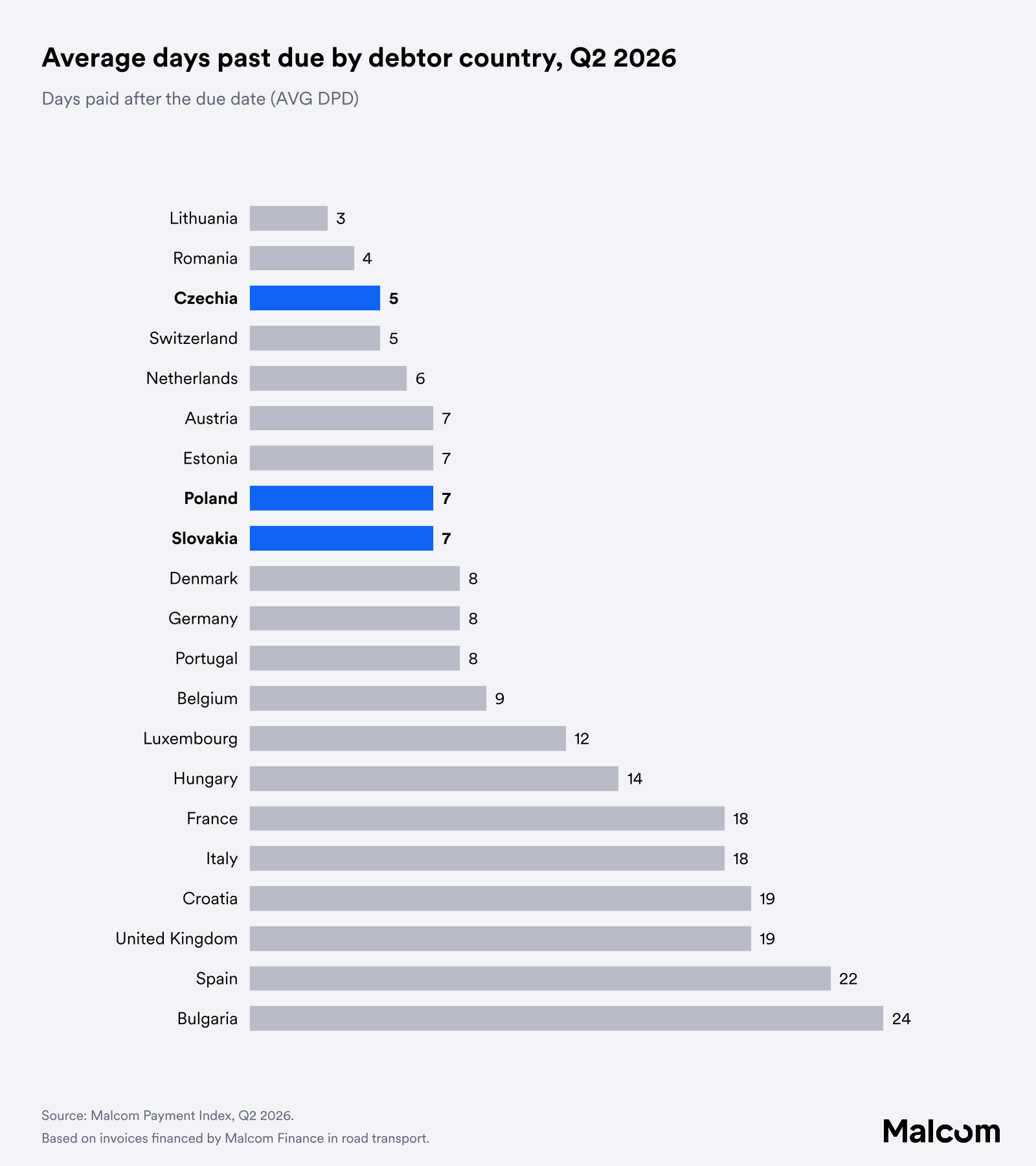
- Czechia: 58 days (53 days maturity + 5 days past due), down 1 day on Q1 2026 and 4 days year on year.
- Slovakia: 57 days (50 + 7), up 2 days on its record-low Q1 2026, but 2 days better year on year.
- Poland: 57 days (50 + 7), down 6 days on Q1 2026 and 9 days year on year – its best result since measurement began in 2023.
Values are rounded to whole days, so a one-day difference between markets should not be read as a clear ranking.
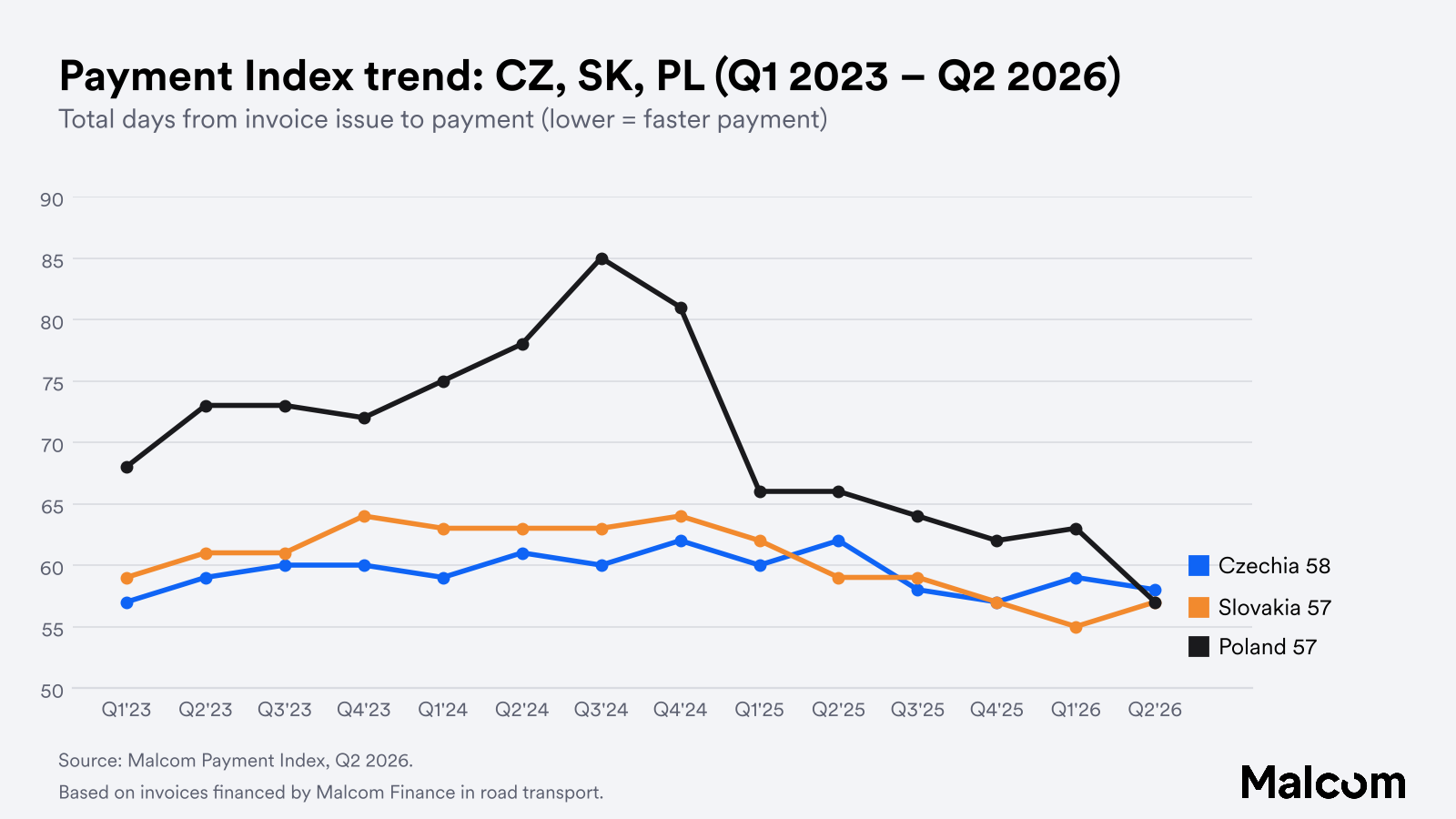
Poland’s average delay fell from 20 days in Q1 2026 to 7 days in Q2 – the lowest on record for the Polish market. Throughout 2024, delays stayed at 20–21 days; in 2025 they ranged from 9 to 13 days. At the same time, maturity returned to 50 days after an unusually low reading of 43 days in Q1, which now looks like a one-off rather than a lasting shortening of payment terms.
Compared with the Q3 2024 peak of 85 days (65 + 20), carriers in Poland now wait 28 days less. One quarter is not a trend, though: after a sharp jump in delays in Q1 and an equally sharp drop in Q2, the next readings will show whether 7 days is the new normal.
In Czechia, maturity stayed at 53 days, the lowest since 2021, and delays eased from 6 to 5 days. For the first time, Czechia has the highest index of the three markets – not because debtors pay later (its 5-day delay is the lowest of the three), but because agreed payment terms are longer.
In Slovakia, maturity held at a record-low 50 days, but delays rose from 5 to 7 days, the highest since Q4 2024. The 57-day result still ties with Q4 2025 as Slovakia’s second-best reading, behind only the record 55 days in Q1 2026.
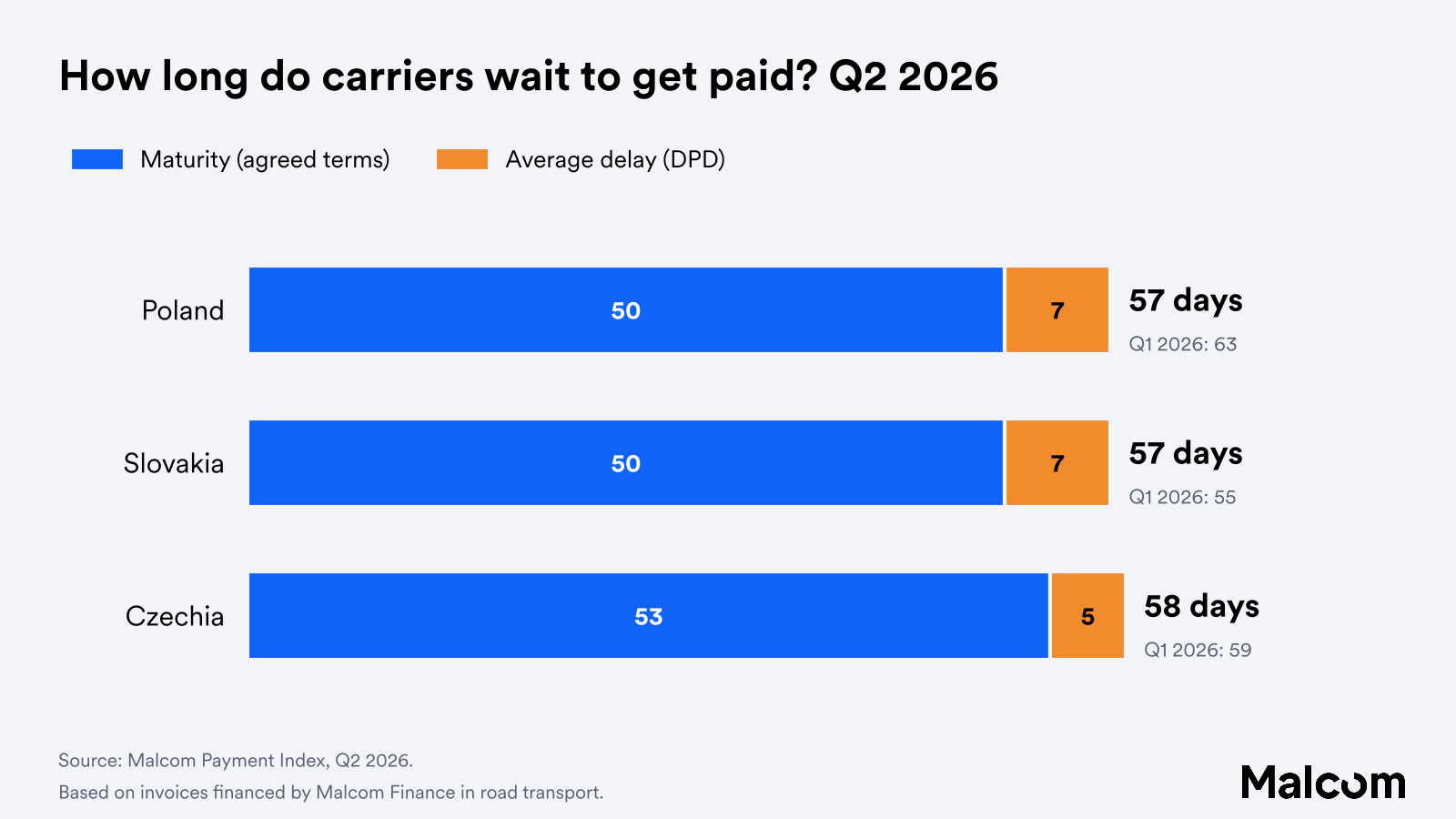
Averaging the two quarters, H1 2026 was the best half-year on record for Slovakia (56 days) and Poland (60 days). Czechia averaged 58.5 days – 2.5 days better than H1 2025, but one day worse than H2 2025, its best half-year to date.
The half-year view also shows what is driving the improvement. Compared with H2 2025, maturity fell in all three markets (Czechia 55 → 53, Slovakia 53.5 → 50, Poland 52.5 → 46.5 days), while average delays rose (Czechia 2.5 → 5.5, Slovakia 4.5 → 6, Poland 10.5 → 13.5 days). Carriers are getting paid sooner mainly because agreed terms are shorter, not because debtors pay more punctually. Poland’s half-year maturity is also pulled down by its unusually low Q1 reading, and its strong Q2 delay figure has not yet changed the half-year picture. (Half-year values are the average of the two quarters.)
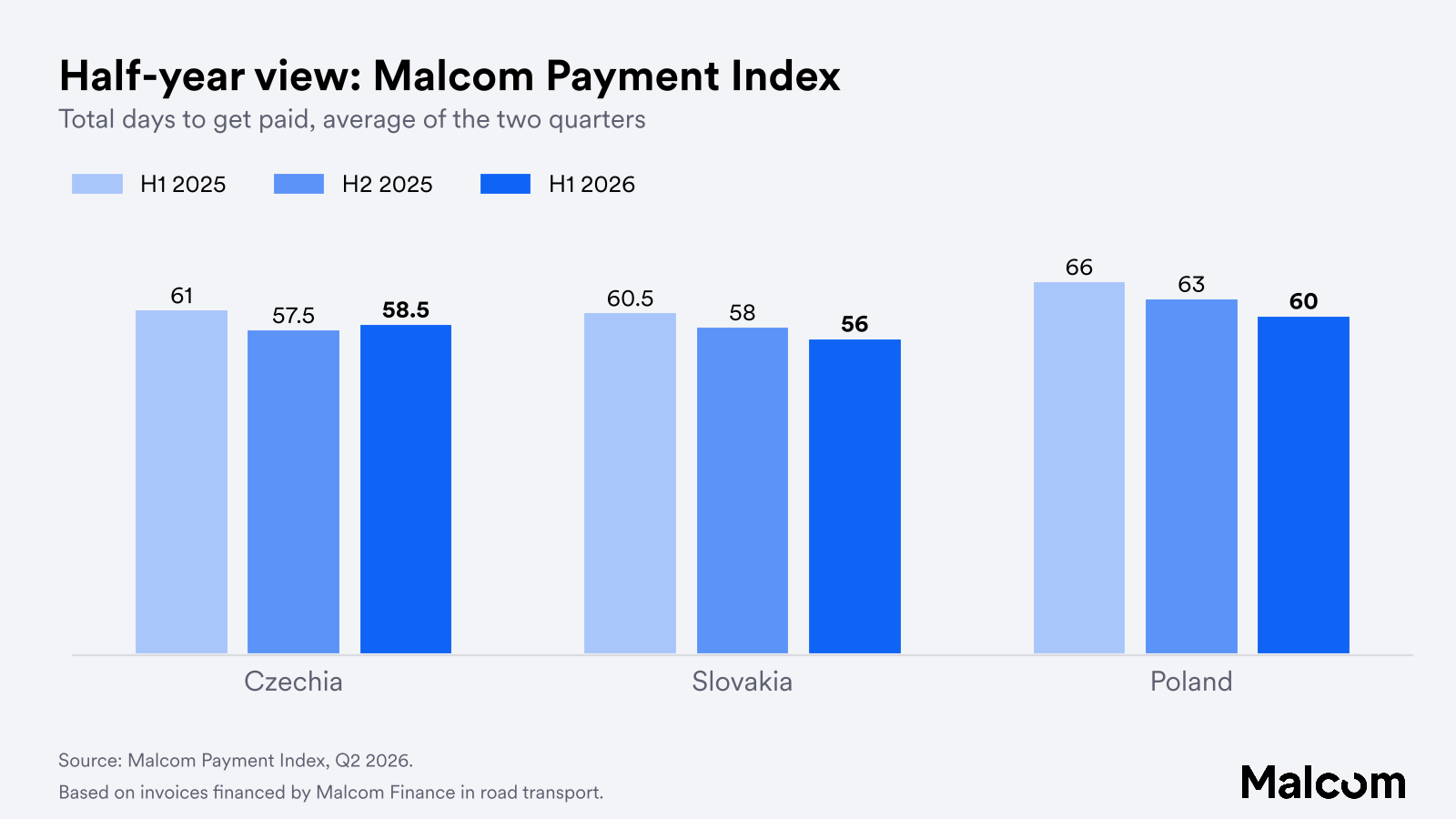
The index also covers debtors from 21 European countries. In Q2 2026, debtors from Lithuania (3 days), Romania (4 days), Czechia and Switzerland (5 days each) paid closest to the due date. The longest delays came from debtors in Bulgaria (24 days), Spain (22 days), Croatia and the United Kingdom (19 days each), and France and Italy (18 days each).
The largest quarter-on-quarter deterioration was among debtors from Germany (+26 days, from paying before the due date to 8 days late) and Croatia (+20 days). The biggest improvements came from Lithuania (−30 days), Austria and Denmark (−17 days each) and Poland (−13 days).
Taking agreed terms into account, carriers were paid fastest by debtors from Switzerland (36 days in total) and Lithuania (38 days), largely thanks to short maturities. The longest total waits were for debtors from Luxembourg (74 days) and Spain (73 days).
The Malcom Payment Index is the sum of two values: average maturity (days from invoice issue to the contractual due date) and average days past due (how many days after the due date the invoice is actually paid). The result shows how many days a carrier would wait for payment if they did not use factoring. The lower the index, the faster carriers get paid.
The index is based on more than 350,000 invoices financed by Malcom Finance in road transport and a database of 120,000 verified debtors across Europe. It describes payment behaviour in Malcom Finance’s portfolio rather than the market as a whole. Country data is published from Q1 2021 for Czechia, Q1 2022 for Slovakia and Q1 2023 for Poland. Results are published with a delay, because a reliable picture requires invoices from the quarter to be settled first.
Convergence at 57–58 days is good news for Poland in particular, but across the region it still means almost two months between delivering a load and getting paid. Fuel, drivers’ wages, lease payments and tolls are paid as they fall due, so carriers finance their own work for that entire period. And a good average does not mean every debtor pays well: country-level results can swing by tens of days from one quarter to the next, which makes checking and monitoring debtors worthwhile.
Malcom Finance helps carriers shorten the wait: we finance invoices, insure them against non-payment and provide a database of verified debtors, including data on their payment behaviour.
Schedule a no-obligation consultation with our advisor:
Michal Kopřiva | kopriva@malcom.app | contact@malcomfinance.com
- Share:
- Email ↗
- Facebook ↗
- LinkedIn ↗

Your money will be available immediately with no hidden fees.

You always have enough money for operating costs and unexpected expenses.

You have a strong partner in case your customer fails to pay on time.

Verify their payment history and reduce the risk of financial loss.