Fuel cards in road transport: types, solutions across Central Europe and the impact on cash flow
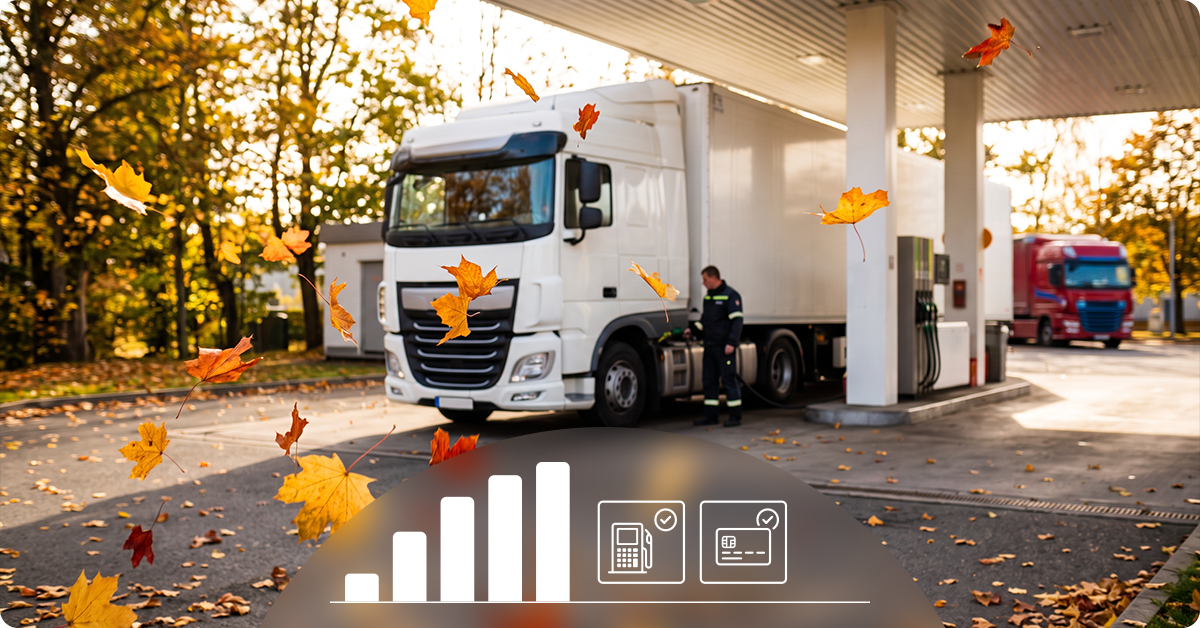
For a road transport company, fuel is typically one of the two largest operating costs, alongside driver wages. How a company pays for it affects more than expense control – it affects the company’s cash flow. Fuel cards have been a standard tool in transport, freight forwarding and logistics sectors for years, but the market has diversified sharply: from simple single–network loyalty cards to international solutions bundling fuel, tolls and VAT refunds. This article gives a general overview of how fuel card types differ, what kind of solutions carriers across Poland, the Czech Republic and Slovakia typically use, how the mechanics work in practice, and – often overlooked – how using a fuel card affects a company’s liquidity.
Fuel cards fall broadly into two categories:
- closed–loop, single–network cards are tied to one fuel retailer – such as Orlen, MOL, Slovnaft, OMV or Shell – and only work at that brand’s own stations. They’re simple and usually cheaper to run, but limited in reach, which complicates planning international routes;
- open, multi–network cards from operators such as DKV Mobility, UTA (Edenred) or Eurowag are accepted across many station brands, both domestically and abroad, and typically bundle fuel with toll payments and VAT/excise duty refunds on cross–border purchases.
Regional players add another layer: CCS operates a widely accepted multi–brand card across the Czech Republic and Slovakia, while Eurowag – founded Czechia in 1995 and now listed on the London Stock Exchange – has grown into one of Europe’s larger fuel–and–toll card providers. Increasingly, digital, app–based cards are replacing the physical plastic altogether.
The three markets share the same broad structure but differ in the details. In each country, national fuel brands (Orlen in Poland, Benzina/MOL/Shell/OMV in Czechia, Slovnaft/OMV/Shell in Slovakia) offer their own closed–loop cards, simplest for carriers running mostly domestic routes. Sitting alongside them, the major international networks – DKV Mobility, UTA Edenred and Eurowag – offer thousands of acceptance points within each country and tens of thousands across Europe, combining fuel with toll settlement (via on–board units linked to each country’s electronic tolling system) and VAT/excise recovery. The Czech and Slovak markets also have CCS, a domestically rooted multi–brand card with broad station coverage and both prepaid and deferred–payment variants. Exact discounts, fees and credit limits vary by provider, country and negotiated volume – carriers should request a current, market–specific quote rather than rely on general marketing figures, several of which conflict across public sources.
The mechanics are similar across providers: the driver fuels without paying cash, the card is linked to a vehicle or driver and protected by a PIN, and transaction limits can be set to match tank capacity. Purchases are consolidated into a single periodic invoice instead of dozens of receipts, typically billed on a biweekly or monthly cycle depending on the provider.
Cards come in two basic forms: prepaid (the company funds the account first, carries no credit risk, and usually pays no issuance fee) or deferred–payment (the provider extends a credit limit based on the company’s financial standing, and payment is settled after the billing period).
Fuel discounts are generally modest for smaller fleets and become more significant at higher, negotiated volumes; several providers also charge a monthly card fee or transaction commission, which can offset the discount for low–volume users – worth calculating against actual fuel spend rather than assumed from headline marketing rates.
The main advantage is control: a company sees every vehicle’s and driver’s spend in real time, keeps cash out of drivers’ hands, and automates bookkeeping through consolidated invoicing. Multi–network cards additionally shift much of the toll and cross–border VAT–refund administration onto the card provider.
On the downside, card cloning and skimming are a genuine, recognized risk in the sector, which is why transaction limits and alerts matter rather than being a formality. Advertised discounts shift over time and depend on negotiation, so they should be verified rather than assumed. Deferred–payment cards require a credit assessment – a potential barrier for younger or smaller carriers – and provider contracts often run for longer terms, which limits flexibility to switch suppliers.
This is the point that’s often missed in discussions of fuel cards, yet it matters most to a carrier. A deferred–payment fuel card functions as short–term trade credit: fuel is consumed immediately, and payment falls due only after the billing period – which genuinely eases pressure on a company’s cash on the cost side. The catch is that the haulage still has to be performed before the client pays for it, and 30–, 60–, or even longer payment terms are common in transport. A fuel card eases the pressure on outgoing cash, but it doesn’t close the gap between the cost of running a job and the client actually paying for it. That’s precisely the gap factoring is designed to close – accelerating the cash from issued invoices instead of waiting out the standard payment term. In practice, the two tools work best together: a fuel card organizes and defers the cost side, factoring accelerates the revenue side, and the company ends up with real cash on hand for fuel, wages and lease payments – instead of waiting weeks for a client to pay.
Fuel prices, discounts, fees and terms for individual fuel cards change frequently and vary by provider, volume and negotiated terms – verify the current offer directly with the chosen provider before making a decision.
- Share:
- Email ↗
- Facebook ↗
- LinkedIn ↗

Your money will be available immediately with no hidden fees.

You always have enough money for operating costs and unexpected expenses.

You have a strong partner in case your customer fails to pay on time.

Verify their payment history and reduce the risk of financial loss.